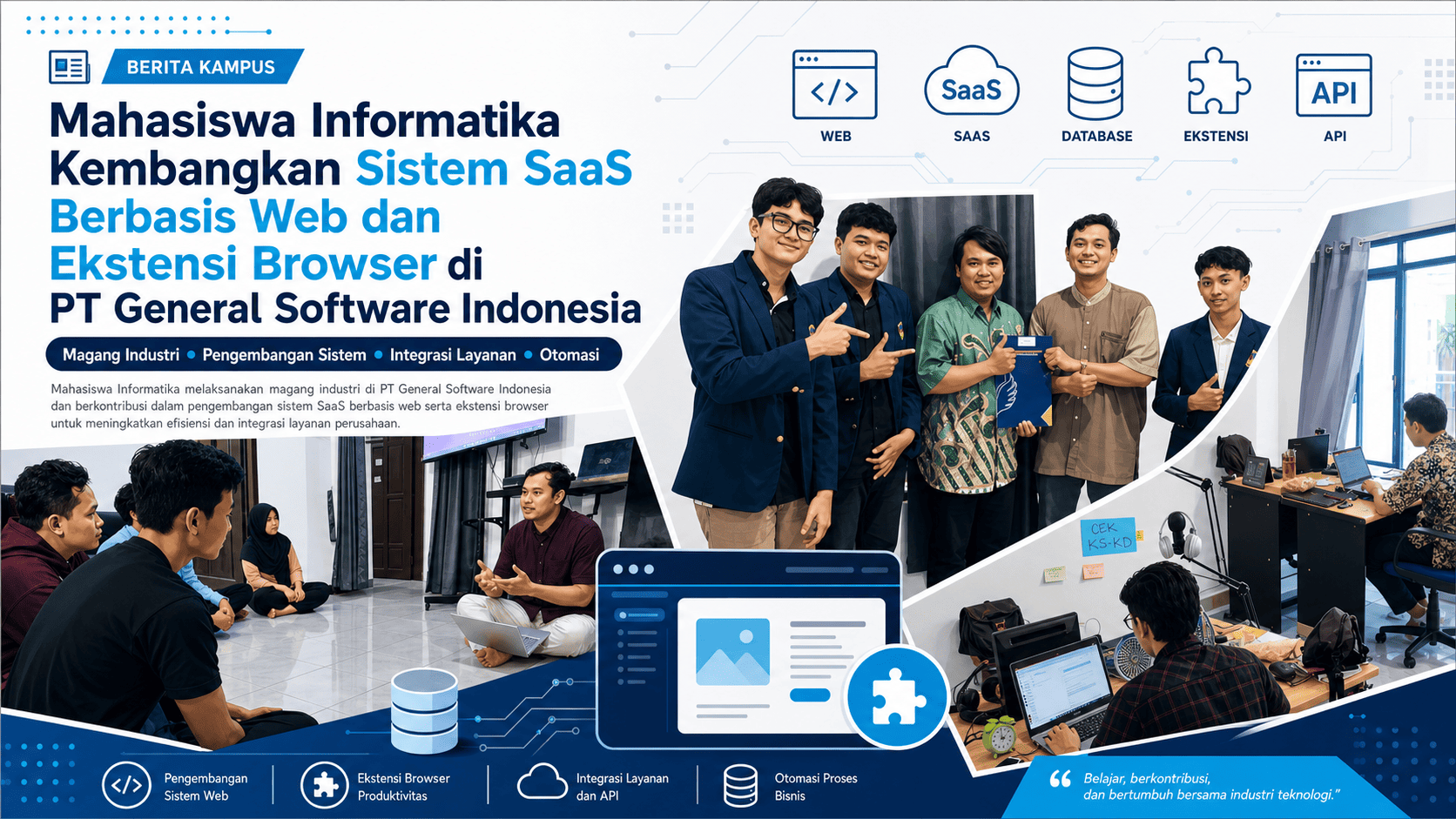

Semarang, April 16, 2026 — Advances in information technology are driving companies to develop digital systems that support operational processes in a more structured, secure, and efficient manner. Through an industrial internship at PT General Software Indonesia, Informatics students have the opportunity to be directly involved in the development of web-based Software as a Service (SaaS) systems and browser extensions.
This internship focused on developing a digital service system with several key components, including a website, user dashboard, backend API, database, admin panel, payment gateway, browser extension, user support, activity logs, system security, and workflow automation. The development aimed to build a system that is not only accessible through a web interface but also capable of managing data, transactions, user access, and operational processes in an integrated manner.
Introduction to Work Environment and System Requirements Analysis
The internship begins with an introduction to the work environment, guidance from a field supervisor, and an understanding of the company's systems development workflow. During this phase, students learn how system requirements are gathered, analyzed, and translated into implementable feature designs.
The requirements analysis process is a crucial stage because the system being developed has many interconnected components. Students examine functional requirements, such as user account management, digital transactions, support services, activity logging, an admin panel, and browser extension integration. Furthermore, they also consider non-functional requirements, such as access security, system stability, ease of maintenance, and data consistency.
Through this process, students understand that SaaS system development focuses not only on the interface but also requires clear backend, database, and service integration design. Each component must have a focused function for the system to run stably and be easily developed.
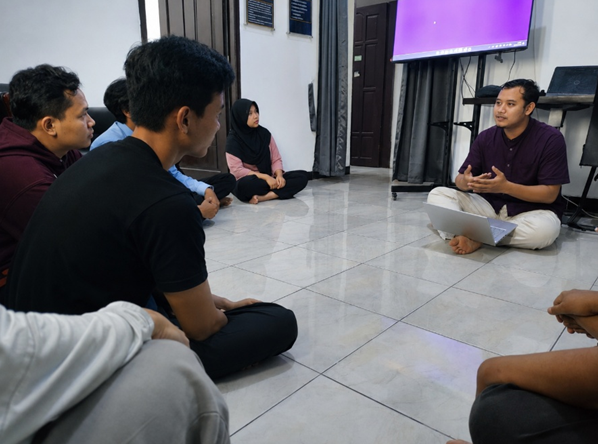
Students participate in discussions and evaluations of system requirements with field supervisors as part of the learning process in an industrial environment.
Web-Based System Design and Browser Extensions
After understanding the system requirements, students learn about system architecture design. The website is designed as the primary user interface, while the backend API serves as the data processing center and the link between the frontend, database, and external services. The database is used to store user data, transactions, service configurations, activity history, and other supporting data.
Browser extensions are a crucial component of a system because they expand user access through the browser. In developing them, students learn how extensions communicate with backend APIs, manage user access, and perform specific functions as needed by the system. Extension development also takes into account permission constraints to ensure that granted access remains appropriate and does not pose security risks.
System design is also supported by technical documentation, such as use case diagrams, activity diagrams, class diagrams, and database relational designs. This documentation helps explain the system's workflow, relationships between actors, key processes, and the data structures used. A clear design allows for a more focused implementation process.
Frontend, Backend API, and Database Implementation
During the implementation phase, students are involved in front-end development, which serves as the user interface. This section includes the main page, dashboard, forms, data tables, navigation, and other visual components used to facilitate user access to system features. The front-end serves not only as a display but also as a link between users and the system processes running on the back-end.
The backend API is developed to handle the system's core logic, such as authentication, request validation, transactions, data management, activity logging, and communication with supporting services. Every request from the frontend or browser extension needs to be processed through the backend so that incoming data can be validated and stored correctly.
Databases are a key component in maintaining data consistency. User data, transactions, payment status, system configuration, and activity history are stored in a structured manner so they can be reused as needed. Through this process, students understand the importance of good database design in supporting the stability of digital systems.
Payment Gateway Integration and User Support Services
The developed system also features payment gateway integration to support digital transactions. This integration encompasses transaction creation, payment callback reception, transaction status validation, and database data updates. This process requires careful design to ensure payment status remains consistent and traceable by system administrators.
In addition to payment integration, the system also supports user support services in the form of a chatbot and live chat. The chatbot is used to provide initial responses to user inquiries, while live chat provides a direct communication channel when users need further assistance. This combination of services aims to improve communication effectiveness between users and system administrators.
Activity logs are also implemented as part of system monitoring. By logging activity, managers can identify data changes, user activity, transactions, and important processes occurring within the system. This feature facilitates monitoring by eliminating the need for managers to manually review each process.
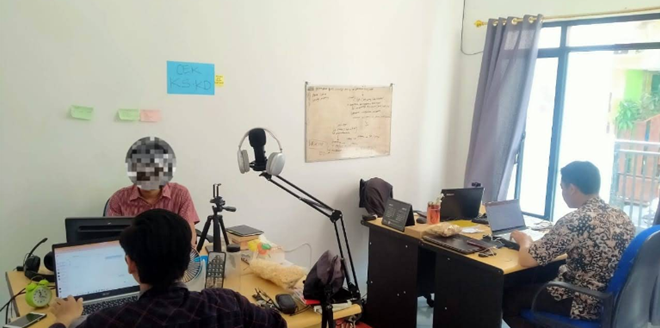
The work environment during the internship supports the discussion process, feature evaluation, and technology-based system development.
Security Implementation and Workflow Automation
Security is a crucial aspect of developing web-based SaaS systems and browser extensions. Students learn how to implement authentication, authorization, user verification, access restrictions, request protection, and API endpoint security. Security is essential because the system handles user data, transactions, and access to various features.
Security also applies to admin access, front-end and back-end communication, and integration with external services. Every process involving data and transactions must be validated to prevent unauthorized requests or inaccurate data from being received. Therefore, system security is not just an optional feature but an integral part of the core development design.
In addition to security, students also learn the application of workflow automation to support system maintenance. Automation is used to assist with repetitive technical tasks, such as checking specific processes, data processing, service integration, and sending notifications. Automation allows operational processes to run more systematically and reduces reliance on manual checks.
System Testing and Evaluation
After developing the features, students conducted testing to ensure the system performed as expected. Testing was conducted using a black-box approach, which involves examining system functionality based on input and output without examining the internal code structure. Features tested included login, user dashboard, admin panel, transactions, payment callbacks, support services, activity logs, browser extensions, access security, and workflow automation.
Test results are used as a basis for evaluation and improvement. If problems are encountered, students recheck the system flow, API configuration, database structure, and service integration. This process provides an understanding that software development requires repeated testing to ensure the stability of the built features.
Evaluation activities with field supervisors are also a crucial part of the internship process. Through these evaluations, students receive guidance on feature improvements, system flow design, and tailoring development results to company needs.
Strengthening Technical and Professional Competencies
Through this internship, students gain hands-on experience in comprehensive web-based system development. Developed technical competencies include requirements analysis, system design, front-end development, back-end APIs, databases, browser extensions, payment gateway integration, application security, feature testing, and workflow automation.
In addition to technical competencies, students also develop professional skills, such as communication, discipline, responsibility, accuracy, and problem-solving skills. In an industrial work environment, students are required to accept direction, communicate work progress, conduct evaluations, and improve their work based on input from their field supervisors.
This internship also serves as a bridge between lecture theory and industry practice. Concepts learned in web programming, databases, software engineering, system security, and application testing can be directly applied to real-world projects.
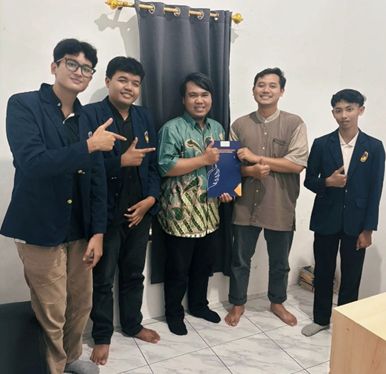
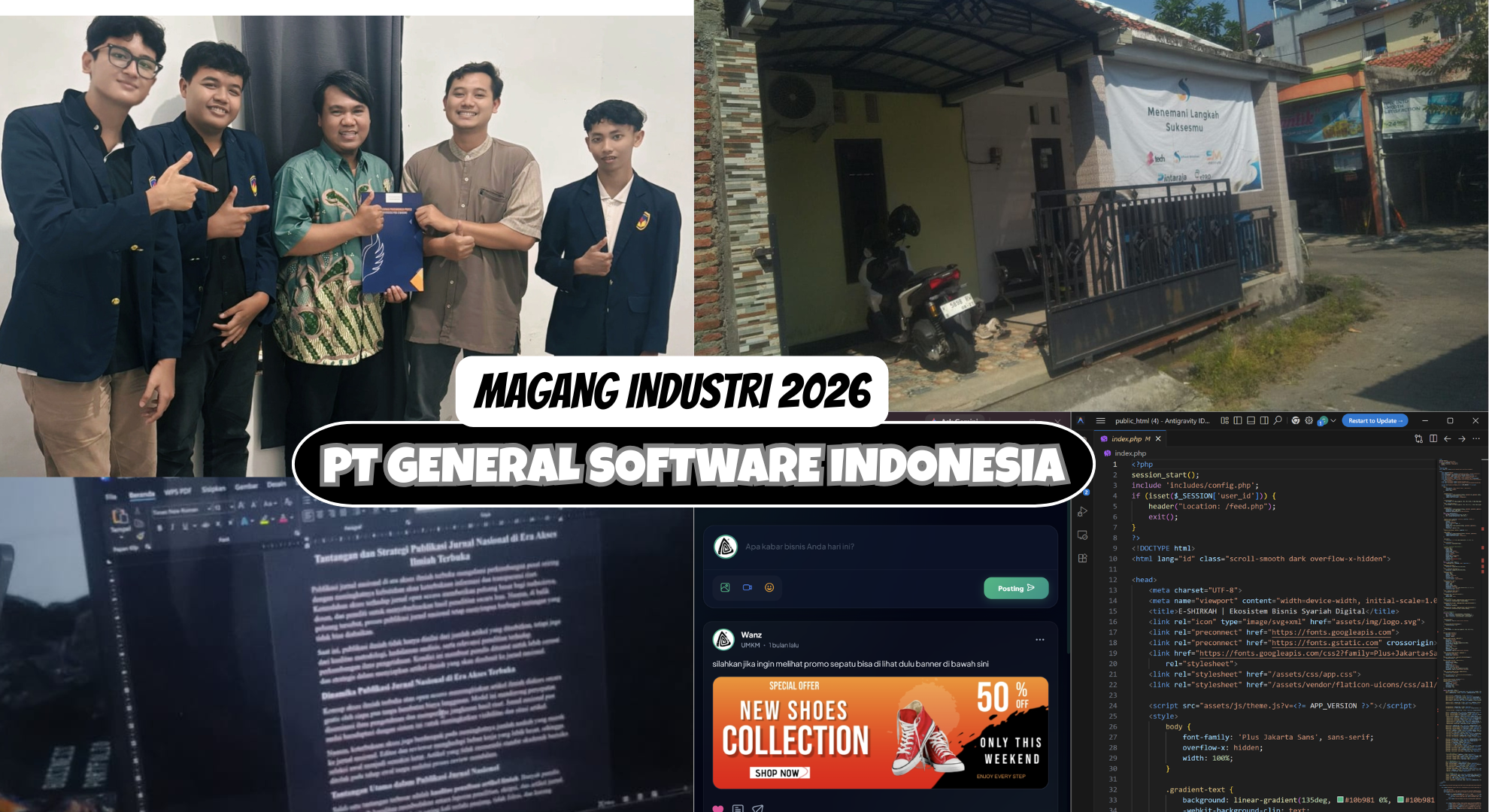
Final documentation of internship activities as a form of program completion and appreciation of the learning process in the industrial world.
Overall, the internship at PT General Software Indonesia provided valuable experience in understanding the development process of web-based SaaS systems and browser extensions. The systems developed demonstrated that modern applications require a seamless integration between user interfaces, backend APIs, databases, transaction services, security, activity logging, support services, and workflow automation. Through this experience, students are expected to be better prepared to meet the demands of the workforce, which increasingly emphasizes system integration, data security, operational efficiency, and the sustainable use of digital technology.